The fashion industry stands at a crossroads, where sustainability is no longer a choice but a necessity. Among the innovative approaches emerging to address textile waste, modular clothing with disassembly capabilities has captured the imagination of designers and environmentalists alike. This concept reimagines garments as temporary assemblies of components, each with distinct lifespans and recycling pathways—a radical departure from traditional monolithic designs destined for landfills.
Breaking the Fast Fashion Cycle
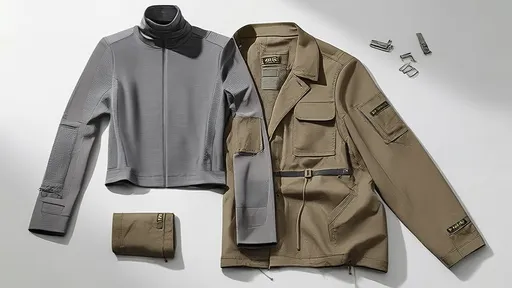
Conventional apparel manufacturing follows a linear model: produce, consume, discard. The average garment, constructed with blended fabrics and permanent adhesives, becomes unrecoverable waste after use. Modular design disrupts this cycle by treating clothing as a dynamic system. Jackets with zip-off sleeves, interchangeable knit panels, or magnetic pocket attachments aren't just stylistic choices—they're recovery mechanisms. When a sleeve wears out or a collar stains, only the affected module requires replacement, preserving 80-90% of the garment's materials.
The materials science behind this movement proves equally fascinating. Researchers at the Hong Kong Research Institute of Textiles and Apparel have developed color-changing polymer threads that indicate structural fatigue. These "smart seams" fade from blue to gray when stitches approach failure points, signaling which modules need preventive replacement. Meanwhile, German startup CircuLoom pioneers bio-welded joints that dissolve in specific pH solutions, allowing effortless separation of cotton sleeves from polyester bodices during recycling.
The Logistics of Circular Wardrobes
Implementing modular systems extends beyond design studios. Urban collection networks must adapt to handle component-level sorting—a challenge addressed by Amsterdam's ReHub facilities. Their automated disassembly lines use spectral imaging to identify material compositions, then deploy robotic cutters to separate modules at predetermined weak points. Consumers participate through app-connected clothing profiles that track each component's lifecycle, suggesting optimal replacement intervals based on real-time wear data.
Critics initially questioned whether modularity compromises durability. However, field tests by outdoor brand AlpineX revealed surprising results: their modular hiking pants showed 30% longer functional lifespans than traditional designs. The secret lies in distributed stress points—when one module absorbs impact, surrounding areas remain intact. This distributed load principle, borrowed from aerospace engineering, creates garments that adapt to failure rather than catastrophically tearing.
Cultural Shifts in Ownership
Perhaps the most profound impact emerges in changing consumer relationships with clothing. Modular systems foster a "stewardship mindset," where users maintain and upgrade garments over years. Tokyo-based label UnStitch hosts monthly repair cafes where customers learn module replacement techniques while socializing. Their loyalty program rewards kept garments rather than new purchases—a behavioral nudge reducing impulse buying by 47% among members.
The economic implications are equally transformative. While modular garments carry 15-20% higher upfront costs, lifecycle analyses demonstrate 60% savings over five years. Luxury conglomerates now explore modularity as an anti-counterfeiting measure—authenticated modules with blockchain-tracked histories create tamper-evident compositions impossible to replicate fully.
As this movement gains momentum, questions linger about stylistic limitations and industrial retooling costs. Yet with the first modular collections from H&M and Zara hitting stores this season, the industry signals its commitment to scalable solutions. The era of disposable fashion may finally meet its match in garments designed from the outset for graceful disintegration.

By /Aug 1, 2025

By /Aug 1, 2025

By /Aug 1, 2025

By /Aug 1, 2025

By /Aug 1, 2025

By /Aug 1, 2025

By /Aug 1, 2025

By /Aug 1, 2025

By /Aug 1, 2025

By /Aug 1, 2025

By /Aug 1, 2025

By /Aug 1, 2025

By /Aug 1, 2025

By /Aug 1, 2025

By /Aug 1, 2025
By /Aug 1, 2025

By /Aug 1, 2025

By /Aug 1, 2025

By /Aug 1, 2025

By /Aug 1, 2025
